The Challenge: A well-run nonprofit hospital with strong market fundamentals couldn't execute on its strategy—not because the analysis was wrong, but because leadership couldn't stop relitigating every decision.
The Background: Our client was a mid-sized nonprofit hospital in a growing suburban market. Well run and well respected, the organization had favorable market conditions: steady population growth, aging demographics, and competitors struggling with negative public perceptions.
On paper, everything pointed toward growth. In practice, the leadership team was stuck.
The problem wasn't a lack of data or strategic options. Previous planning efforts had produced detailed market analyses and reasonable recommendations. But without a unifying Strategic Ambition, every new opportunity triggered a new debate. Should we expand primary care in the neighboring county? Launch a new service line? Respond to a competitor's move? Each decision was evaluated in isolation, and each meeting felt like starting from scratch.
Board members described it as "chasing squirrels." Executives described it as exhausting. The pattern was clear: strong analysis, endless discussion, inconsistent execution.
Our Approach: Ascendient was engaged to help the organization break this cycle. Using our LIVING Strategy framework, we recognized that the client's challenge wasn't in the early phases of strategic planning—Looking in the Mirror and Investigating the Environment—but in what comes next: Visualizing a clear future and building the structures to execute against it.
That said, we didn't skip the foundational work. Moving beyond conventional wisdom on market conditions, we developed a granular view of where patients were actually going for care—service-by-service across dozens of ZIP codes. In addition to current conditions, we overlaid demographic trends to see how demand was likely to change over time.
The Findings: Within its home county, our client enjoyed a leading position in primary care, urgent care, and surgery, supported by a growing population and high satisfaction scores.
Meanwhile, past investments in neighboring counties were working: patients were increasingly choosing our client for tertiary care rather than the dominant teaching hospital one county over.
Most surprisingly, in a market the client had long ceded to a much larger competitor, low satisfaction data suggested real opportunity. The data told a clear story—but data alone wouldn't solve the execution problem.
The analysis revealed distinct competitive dynamics across four submarkets, as shown in the stylized map below:

The Turning Point: The pivotal moment came not from the market analysis, but from the strategic conversation it enabled. Working with the board and executive team, we facilitated a series of discussions that moved beyond "what does the data say?" to "what do we want to become?"
The answer, once articulated, was clear and specific: Our client would evolve from a community hospital into a regional health system.
This wasn't a vague aspiration—it was a Strategic Ambition that named exactly what the organization intended to become. It became the filter for every investment decision, every partnership conversation, every board discussion. When a new opportunity emerged, leadership could now ask a simple question: "Does this advance our regional ambition, or is it just a shiny object?"
With the ambition established, we worked with leadership to define specific competitive stances for each submarket:
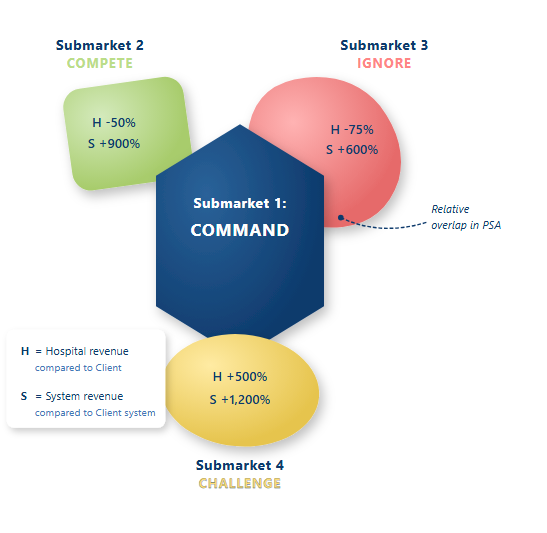
- Submarket 1 (Home County): COMMAND — Defend and extend market leadership
- Submarket 2: COMPETE — Invest in targeted service lines to capture growing demand
- Submarket 3: IGNORE — Declining population and changing competitive dynamics made additional investment unwise
- Submarket 4: CHALLENGE — New primary care and urgent care locations could repeat the successful growth pattern from other markets
From Ambition to Accountability: A Strategic Ambition, no matter how compelling, won't execute itself. This is where most strategies fail—not because the ambition was wrong, but because organizations default to operational firefighting and abandon strategic discipline.
To prevent that outcome, we worked with leadership to establish clear ownership structures. Each executive initiative was assigned to one—and only one—senior leader who would be accountable for driving progress. No more diffuse responsibility. No more "the team owns it" (which typically means no one owns it).
We also developed decision frameworks that connected every major investment request back to the Strategic Ambition. Capital expenditures, technology acquisitions, and partnership opportunities would all be evaluated against the same criteria. This gave leadership the confidence to say "no" quickly—and the rationale to explain why.
Finally, we documented the strategic logic behind key decisions. When leadership understands why a strategy was chosen, they can adapt intelligently when circumstances change—rather than either rigidly following an outdated playbook or abandoning strategy altogether at the first sign of turbulence.
The Outcome: With a clear Strategic Ambition and accountability structures in place, the pattern of endless relitigating stopped. Board meetings shifted from circular debates to focused progress reviews. Executives who had previously been pulled in multiple directions could now concentrate their energy on initiatives they personally owned.
The organization moved forward on its regional expansion with confidence—opening new access points, growing select service lines, and building the integrated system its Strategic Ambition described. Perhaps more importantly, when unexpected opportunities arose (as they always do),leadership had a framework for evaluating them rather than a reason for another exhausting debate.
Strategy didn't just get planned. It got executed.